In the spring of 2019, the District budgeted $798,745 for a renovation project at Walter Pierce Park that included a new restroom at the Adams Mill Road entrance. The project was supposed to wrap by April 2020. It didn't open until this year, roughly six years past its own deadline, a delay confirmed by a March 2026 PoPville post whose headline said simply that the wait was finally over.
A few blocks away, inside Kalorama Park, a group of volunteers named Diana and Sterling looked at a stretch of abandoned, weed-choked ground above the basketball courts and turned it into terraced beds of black-eyed Susans and coneflowers. No agency budgeted it. No phase-two contract governed it. It got built because people who live nearby decided it should exist, and then it did.
Walk this corridor of Adams Morgan and Kalorama's edge this fall and you're really walking through two different timelines running side by side. One belongs to the city, with its procurement cycles and phased construction schedules. The other belongs to neighbors who never waited for permission. Almost everything worth seeing on this loop was built, maintained, or rescued by residents rather than delivered on a government calendar, and understanding which is which changes how you read the place.
One park, two completely different operating systems
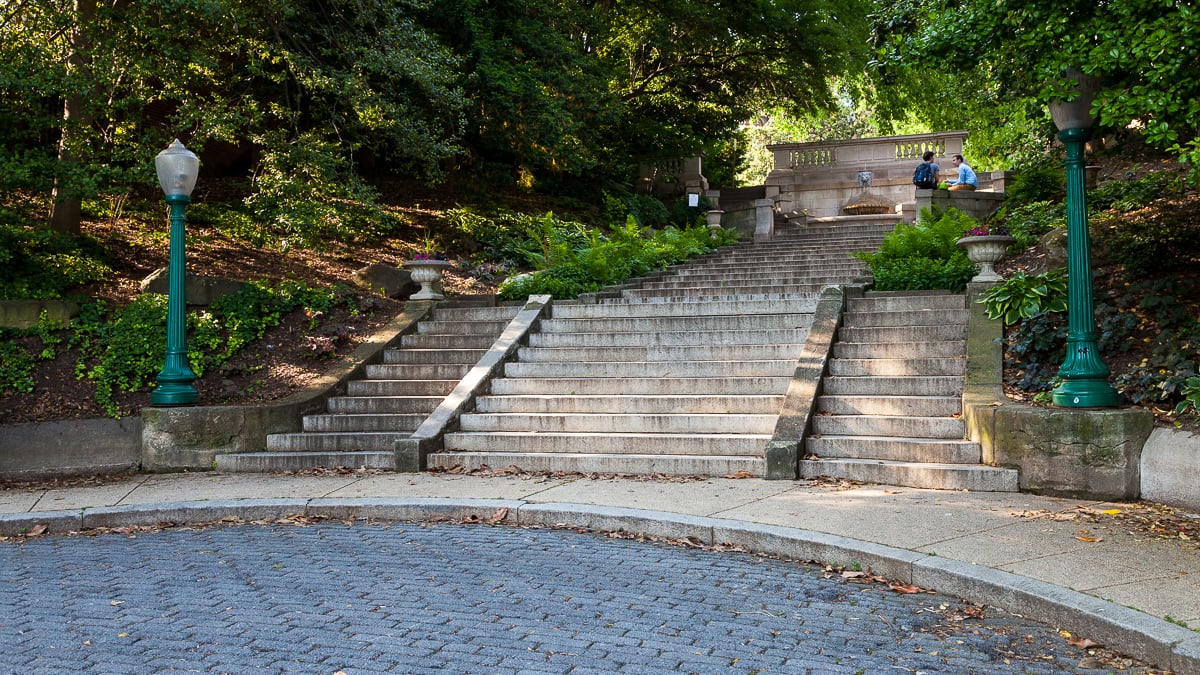
Kalorama Park sits on the north side of Columbia Road between Kalorama Road and Mintwood Place, a three-acre wooded slope that the Kalorama Citizens Association spent decades lobbying to get dedicated in the first place. It finally opened in 1949. Inside its boundaries today, you'll find two garden projects that could not run more differently.
The first is the 19-plot community garden the DC Department of Parks and Recreation manages at Kalorama and Columbia Roads. It works on a lottery: interested residents enter, and if selected, they hold the plot for years as long as they stay in the area. It's a government program with a government structure, waitlists and all.
The second is the Mariposa Garden, which sits just above those same basketball courts and answers to nobody but its own volunteers. Every fence post, every woodchip path, every seedling is funded by donations rather than agency budget lines, and the group that tends it explicitly doesn't allow outside events on the grounds because the space exists for the plants and the pollinators, not programming. Two garden models occupying the same three acres, one running on city timelines and one running on whoever shows up with a trowel.
The triangle a neighbor designed himself
Keep walking toward 20th and Biltmore streets and you'll hit the smallest public green space the Kalorama Citizens Association claims: the Biltmore Triangle Garden, a roughly ten-plot planting of roses, irises, and tulips tucked into a traffic island most people drive past without noticing. It wasn't handed down by a parks department master plan. It was designed in 1981 by Gordon Riggle, a landscape architect who lived in the neighborhood himself, and it still runs today on the same footing as it did then: neighborhood volunteers doing the tending, and KCA collecting tax-deductible donations to keep it going.
There's no ribbon-cutting story here, no phase-two contract, no six-year delay. Just a resident who happened to have the right professional skill and used it on the block where he lived.
Where the real waiting happens
Walter Pierce Community Park is where the two timelines diverge most sharply. Tucked behind the rowhouses on the north side of Calvert Street between Biltmore Street and Adams Mill Road, right up against the National Zoo and Rock Creek Park, the park carries a weight most visitors don't clock at first glance: it sits atop two historic cemeteries, one African American and one Quaker, documented to hold more than 8,400 people. The National Park Service named it part of the National Underground Railroad Network to Freedom in 2008, and it's also listed on DC's African American Heritage Trail.
None of that recognition arrived quickly either. The push to document and protect the burial grounds traces back to 2005, when community members and Howard University archaeologists organized to stop earth-moving work at the site once its history became clear. The Ancestors Pavilion, a set of interpretive signs meant to list the names and stories connected to those burials, has been in development for years as part of that same long effort, run in large part by longtime volunteer Mary Belcher and the group behind the Walter Pierce Park Archaeology Project.
Set against that backdrop, the restroom delay reads less like an isolated bureaucratic hiccup and more like a pattern. The 2019 project scope for Walter Pierce Park's Phase II covered both the new signage and the restroom installation. One of those pieces, the plumbing, took roughly six years longer than its own paperwork promised. The other, the historical memory work, has taken closer to two decades and counts as ongoing. Government projects here don't move on a government's stated schedule. They move on whatever schedule the neighborhood is willing to keep pushing for.
What a fall walk through here actually shows you
If you want to see the contrast for yourself before the leaves are down, the loop works best in this order:
- Start at Kalorama Park's oval, where the grassy center marks the old footprint of a 19th-century manor house and farm, then climb toward the Mariposa Garden above the courts to see what a fully volunteer-funded planting looks like in September bloom.
- Walk past the DPR community garden plots along Columbia Road and notice how differently they're laid out compared to Mariposa's terraces, one gridded and permitted, the other organic and unpermitted.
- Cut over to the Biltmore Triangle at 20th and Biltmore, easy to miss if you're not looking for it, and see forty-five years of a single resident's landscape design still holding its shape.
- Finish at Walter Pierce Park, where the new restroom near the Adams Mill Road entrance is the freshest thing standing in a park whose most important feature, the burial ground itself, still isn't publicly accessible and may never fully be.
None of these stops require an agenda. They're simply what's here right now, in the specific state this particular September finds them.
The pattern worth remembering
What ties Mariposa Garden, the Biltmore Triangle, the DPR plots, and Walter Pierce Park together isn't a shared design language or a shared funding source. It's that every one of them exists in its current form because residents refused to let the default outcome, whether that's an abandoned weed patch or an unmarked cemetery, stand unaddressed. The Kalorama Citizens Association lobbied for decades to get the original park dedicated in 1949. Neighbors are still lobbying, in effect, every time they push the Ancestors Pavilion project forward or write a check for Biltmore Triangle's flowers.
The city eventually delivers. The restroom at Walter Pierce Park proves that much. But eventually, in this stretch of Northwest, has historically meant years past the date on the paperwork. The gardens that look effortless on a Saturday morning got that way because somebody didn't wait for the paperwork at all.
If you're spending time in this part of town and want a longer conversation about how a specific block, building, or park actually works day to day, not just what the listing photos show, the Hagen Bergstrom Team has spent decades paying attention to exactly this kind of detail across Kalorama and the neighborhoods around it.